


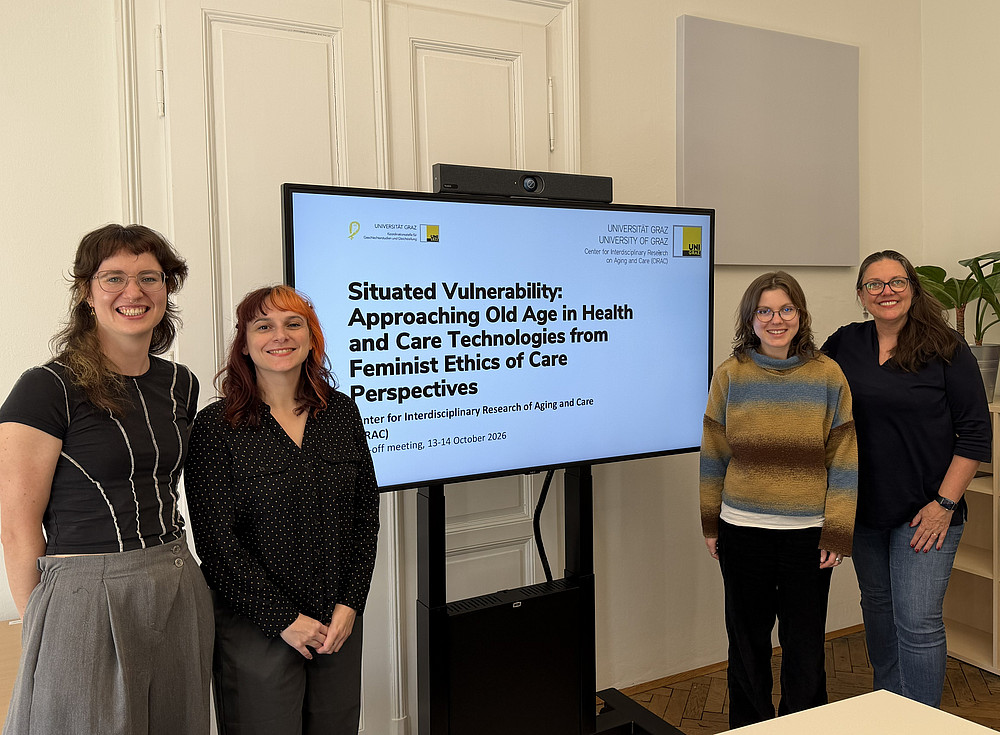
The project ‘Situated Vulnerability: Approaching Old Age in Health and Care Technologies from a Feminist Ethics of Care Perspective’ got underway with a kick-off meeting at CIRAC. The project is funded as part of the University of Graz’s Elisabeth List Fellowship Programme and will run for 20 months.
The project investigates how digital health and care technologies generate and negotiate vulnerability amongst older people. Drawing on feminist ethics of care and Age Studies, it develops the concept of ‘situated vulnerability’ to analyse narratives surrounding older people and health technologies, and to highlight how gendered ageism, paternalism and epistemic injustice are embedded in these technologies. Vulnerability is not understood here as the opposite of agency: rather, the project examines how older people exercise agency through and within their vulnerability when engaging with virtual health and assistive technologies. Their knowledge is to be recognised as epistemically relevant and incorporated into a more equitable, non-paternalistic approach to technology design. The findings will ultimately be translated into concrete recommendations for developers, healthcare institutions and policy-makers.
The project is led by Prof. Ulla Kriebernegg (Local Senior Fellow, CIRAC, University of Graz) and Dr Mónica Cano Abadía (Incoming Senior Fellow) as co-PIs, in collaboration with Junior Fellows Paloeka de Koning and Gesine Buurman. Local partners include Prof. Juliane Jarke and Prof. Giovanni Rubeis (both from the University of Graz), DDr. Susanna Krainz (Styria Health Fund), Dr Jakob Tettmann and Oskar Kohlenprat (Remembria). A high-calibre international advisory board comprising Prof. Nicole Dalmer, Dr Wolfgang Kratky, Dr Daniel López Gómez, Prof. Barbara Marshall, Prof. Kim Sawchuk, Prof. Mark Schweda and Prof. Joan Tronto is supporting the project.