Begin of page section:
Page sections:

  • Go to contents (Accesskey 1)
  • Go to position marker (Accesskey 2)
  • Go to main navigation (Accesskey 3)
  • Go to sub navigation (Accesskey 4)
  • Go to additional information (Accesskey 5)
  • Go to page settings (user/language) (Accesskey 8)
  • Go to search (Accesskey 9)

End of this page section. Go to overview of page sections

Begin of page section:
Page settings:

English en
Deutsch de
Search
Login

End of this page section. Go to overview of page sections

Begin of page section:
Search:

Search for details about Uni Graz
Close

End of this page section. Go to overview of page sections


Search

Begin of page section:
Main navigation:

Page navigation:

  • University

    University
    • About the University
    • Organisation
    • Faculties
    • Library
    • Working at University of Graz
    • Campus
    Developing solutions for the world of tomorrow - that is our mission. Our students and our researchers take on the great challenges of society and carry the knowledge out.
  • Research Profile

    Research Profile
    • Our Expertise
    • Research Questions
    • Research Portal
    • Promoting Research
    • Research Transfer
    • Ethics in Research
    • Commission for Scientific Integrity
    Scientific excellence and the courage to break new ground. Research at the University of Graz creates the foundations for making the future worth living.
  • Studies

    Studies
    • Prospective Students
    • Students
  • Community

    Community
    • International
    • Location
    • Research and Business
    • Alumni
    The University of Graz is a hub for international research and brings together scientists and business experts. Moreover, it fosters the exchange and cooperation in study and teaching.
  • Spotlight
Topics
  • Sustainable University
  • Researchers answer
  • Work for us
Close menu

End of this page section. Go to overview of page sections

Begin of page section:
You are here:

University of Graz Faculty of Humanities Zentrum für Interdisziplinäre Alterns- und Care-Forschung News Call for Papers: The Gerontologist - Special Issue
  • About the Center
  • Researcher Spotlight
  • Our Research
  • Teaching
  • Cooperation and Networks
  • News

End of this page section. Go to overview of page sections

Wednesday, 11 May 2022

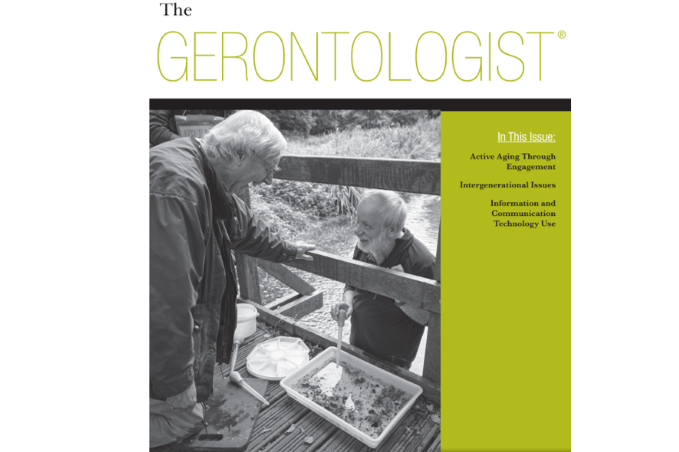
Call for Papers: The Gerontologist - Special Issue

Interdisciplinary Pathways: Humanities, Arts, and Gerontology.

Submit your abstract till July 1, 2022!

Special Issue: Interdisciplinary Pathways: Humanities, Arts, and Gerontology

Editors: Ulla Kriebernegg, Editor, Humanities & Arts, The Gerontologist; and Guest Editors, Sally Chivers and Stephen Katz

This special issue of The Gerontologist explores gerontology and the humanities (including the arts, history, and philosophy) as fields of exchange, rather than as divided or opposing disciplines, whose close (but often unacknowledged) historical contact has created age-making across multiple cultural forms (theater, art, film, fiction, media production, music) and professional practices (texts, conferences, research, teaching, care, policy). While scholars of aging in the humanities adapt gerontological insights, ideas, data, and anti-ageist critiques in their work, gerontological researchers borrow from the humanities its theories, methods, futuristic speculations, and imaginative poetics. Early examples of intersecting literary and scientific textuality were Elie Metchnikoff’s optimistic discussion of Goethe and William Osler’s famous “The Fixed Period” (Trollope) speech. Today, research on health and illness, dementia, retirement, long-term care, population aging, and death and dying continues to widen the opportunities for shared dialogue and discovery between gerontology and the humanities, sometimes through hybridized areas such as the gerontological humanities, and the medical and health humanities. 

The Gerontologist invites contributions to this special issue that highlight significant interactions between gerontology and the humanities, and call attention to how and where their interdisciplinary paths have led to new ways and genres of understanding, representing, expressing, analyzing, challenging, and imagining the meanings of aging and old age. Examples of topics might include but are not limited to the following questions:

  • Where have humanities and gerontology scholars adapted or appropriated each other’s languages, concepts, methods, and vocabularies and with what consequences?

  • Where have gerontological ideas and research emerged in the cultures and experiences of everyday life through popular poetry, drama, fiction, film, media, and visual arts?

  • How have older researchers and writers in the humanities and gerontology informed and advanced interdisciplinary dialogue?

  • What can gerontologists and humanities scholars learn from how their respective fields engage with critical issues of age-based intersectional disadvantage, inequality, colonialism, and exclusion?

  • What future collaborations are possible between the humanities and gerontology that expand both of their horizons? 

  • What has been the relationship between historical ideas about and approaches to aging and old age and the emergence of gerontology or the modern humanities?

To avoid duplicative topics and to enable us to develop a comprehensive issue, a 250-word abstract describing the paper’s intent should be submitted. Please be sure to include all author names and contact information. Our team of editors will identify abstracts of interest and selected authors will be invited to submit full manuscripts. Full manuscripts will be evaluated using The Gerontologist’s usual peer-review process.

Before submission, authors should carefully read the Author Guidelines for The Gerontologist. Abstracts should be submitted electronically through the online submission system according to the following timetable:

Abstracts due: July 1, 2022
Full manuscripts due: January 16, 2023
Issue published: December 2023

Link to the Gerontologist: website
 

Related news

Guest Lecture by Dr. Nina De Bettin Padolin (15 April 2026) ONLINE

"Indigenous Storytelling in the 20th and 21st Centuries: Literature, Disability, and Age" In her guest lecture, Dr. Nina De Bettin Padolin explores Indigenous storytelling traditions of the 20th and 21st centuries and shows how they address aging, disability, and colonial violence.

Anita Wohlmann: "Narrative Medicine: Theory and Practice" — Online Lecture: 14 April 2026

14 April, 5.00 p.m., online (NEW DATE)

Places of Health Practice in Graz: On-Site Visit at "Gesundheitsdrehscheibe" Graz

Students of the Health Humanities Master’s Plus Module visit the "Gesundheitsdrehscheibe" for an on-site experience.

New Publication: Putting Age in Its Place (Ulla Kriebernegg)

Putting Age in Its Place: Long-Term Residential Care in Contemporary Film and Fiction by Ulla Kriebernegg

Begin of page section:
Additional information:

University of Graz
Universitaetsplatz 3
8010 Graz
Austria
  • Contact
  • Web Editors
  • Moodle
  • UNIGRAZonline
  • Imprint
  • Data Protection Declaration
  • Accessibility Declaration
Weatherstation
Uni Graz

End of this page section. Go to overview of page sections

End of this page section. Go to overview of page sections

Begin of page section:

End of this page section. Go to overview of page sections